
Table of Contents
- What Is PPV on OnlyFans
- Strategy 1: The Teaser Funnel
- Strategy 2: Tiered Pricing
- Strategy 3: Limited-Time Exclusive Drops
- How to Price Your PPV Content
- Writing PPV Captions That Convert
- PPV Timing and Frequency
- Mass Messages vs Individual PPV
- Tracking PPV Performance
- How JP Management Optimizes PPV Revenue
Subscription revenue is the foundation of any OnlyFans page, but the creators who earn the most know that PPV is where the real money lives. Pay-per-view content allows you to charge a premium for exclusive pieces that go beyond what subscribers get on your regular feed, and when done right, it can double or even triple your monthly income without requiring you to post more often.
The challenge is that most creators approach PPV without a strategy. They send a random photo with a random price and hope for the best. That approach leads to low open rates, frustrated subscribers, and revenue that never reaches its potential. In this guide, we break down three proven PPV strategies that top-earning creators use, along with practical advice on pricing, captions, timing, and tracking so you can turn PPV into the most profitable part of your OnlyFans business.
What Is PPV on OnlyFans
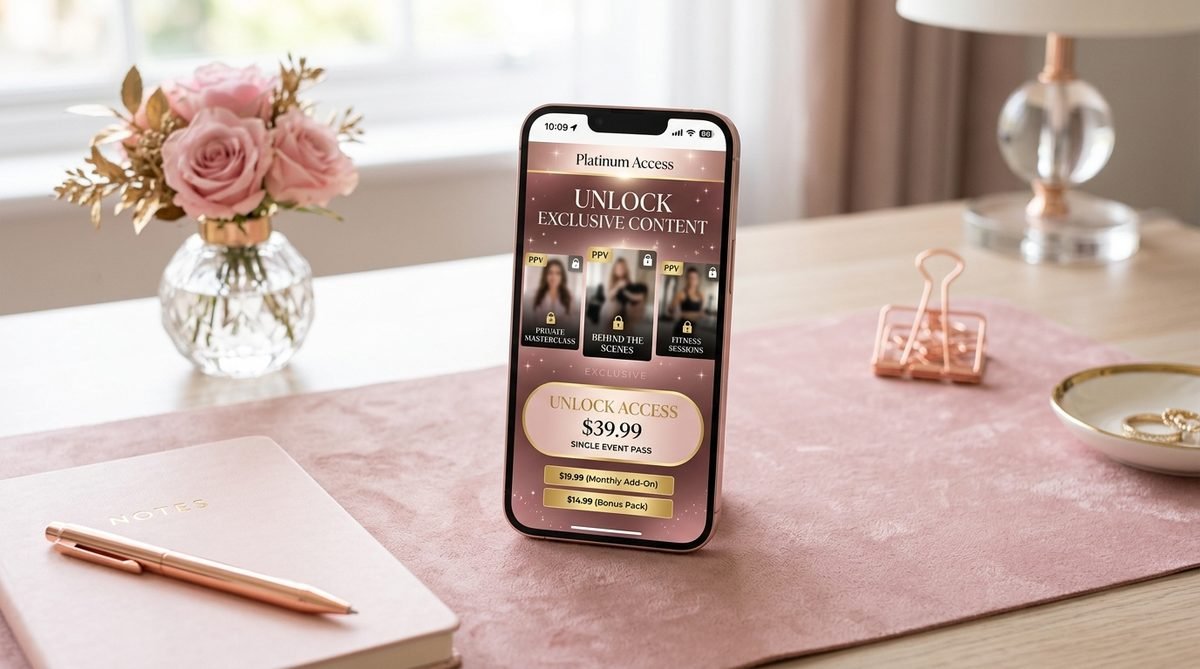
PPV, or pay-per-view, is a feature on OnlyFans that lets creators send locked content to subscribers through direct messages. The subscriber sees a preview or a text description, and they must pay the specified price to unlock the full content. Unlike feed posts that are included in the subscription, PPV is an additional purchase on top of what the subscriber already pays monthly.
There are two primary ways to send PPV on OnlyFans. The first is through mass messages, where you send the same locked content to all of your subscribers (or a filtered segment) at once. The second is through individual messages, where you send personalized PPV to a specific subscriber, often in response to a conversation or a custom request. Both approaches have their place in a well-rounded PPV strategy, and we will cover when to use each one later in this article.
PPV is significant because it changes the economics of your page. With subscriptions alone, your revenue is capped by your subscriber count multiplied by your monthly price. PPV breaks that ceiling by allowing you to earn additional revenue from your existing fan base. A creator with 200 subscribers at $9.99 per month earns roughly $2,000 in subscription revenue. But if that same creator sends two well-crafted PPV messages per week at $15 each with a 30 percent open rate, they add an additional $3,600 per month in PPV revenue alone. That is the power of a solid OnlyFans PPV strategy.
Understanding how PPV fits into the broader revenue picture is essential. For a deeper look at what creators earn across different income streams, check out our breakdown of OnlyFans earnings by level and niche.
Strategy 1: The Teaser Funnel
The teaser funnel is the most reliable PPV strategy on OnlyFans because it leverages a basic principle of human psychology: people want what they can almost see. Instead of sending a PPV message cold, you build anticipation by giving subscribers a free preview that makes them eager to unlock the full content.
Here is how the teaser funnel works in practice. First, you post a short preview to your main feed. This could be a censored version of a photo, the first five seconds of a longer video, or a behind-the-scenes clip from a premium shoot. The preview should be compelling enough to generate interest but clearly incomplete. It needs to make the subscriber think, "I need to see the rest of this."
Second, within a few hours of posting the teaser, you send a PPV message containing the full, uncensored content. Reference the teaser in your message so subscribers connect the two. Something like, "Here is the full version of what I posted earlier... you do not want to miss the ending." The timing gap between the teaser and the PPV is important. Too short and it feels like a bait-and-switch. Too long and the excitement fades. Two to four hours tends to be the sweet spot.
Third, follow up with a casual reminder for subscribers who did not open the first message. A simple "Did you see my last message?" sent 24 hours later can recover 10 to 15 percent of the subscribers who initially passed. This follow-up should feel natural and conversational, not pushy.
The teaser funnel works because it gives subscribers social proof that the content exists and is worth paying for. When they see the teaser on the feed and then receive the full version in their inbox, the decision to unlock feels like a natural next step rather than an impulsive purchase. Creators who use this approach consistently report open rates 40 to 60 percent higher than those who send PPV without a teaser.
Strategy 2: Tiered Pricing
Not all subscribers have the same budget, and not all content has the same value. Tiered pricing acknowledges both of these realities by offering PPV content at multiple price points, allowing you to capture revenue from casual fans and high spenders alike.
A simple tiered structure might look like this. Your entry-level tier, priced between $5 and $10, includes single photos, short clips, or slightly more revealing versions of your feed content. This tier is designed for volume. The price is low enough that most subscribers will unlock it without much deliberation, and the sheer number of purchases adds up quickly.
Your mid-level tier, priced between $15 and $25, includes longer videos, multi-photo sets, or content with a higher production value. This is your workhorse tier where you balance quality with accessibility. Most of your PPV revenue will come from this range because it attracts both casual buyers and engaged fans.
Your premium tier, priced between $30 and $50 or higher, is reserved for your most exclusive content. This might include longer-form videos, content shot in unique locations, or pieces that you only produce occasionally. The premium tier will have a lower purchase rate, but the higher price compensates for that, and it gives your biggest fans an opportunity to access something truly special.
The key to making tiered pricing work is consistency. Your subscribers should learn over time what each price point represents so they can make confident purchasing decisions. If you charge $10 for a single photo one week and $25 for a similar photo the next, you erode trust and create confusion about the value of your content. Establish clear standards for each tier and stick to them.
Tiered pricing also lets you test the market. If your $15 PPV messages consistently outperform your $25 messages in total revenue (not just open rate), that tells you your audience has a strong preference for that mid-range price point, and you should produce more content in that tier.
Want Expert Help With Your PPV Strategy?
JP Management builds custom PPV strategies for every creator we manage, including pricing tiers, caption templates, and send schedules. Our managed creators see an average PPV open rate of 35% or higher. Let us optimize your revenue.
Strategy 3: Limited-Time Exclusive Drops
Scarcity drives action. Limited-time exclusive drops tap into the fear of missing out by making PPV content available for only a short window before it disappears. This creates urgency that pushes subscribers to purchase immediately rather than putting it off and eventually forgetting about it.
The structure is straightforward. Announce that you are releasing a special piece of content that will only be available for 24 or 48 hours. Send the PPV message with a clear deadline in the caption, and then follow through by not resending it after the window closes. The content goes away, and subscribers who missed it learn to act faster next time.
For this strategy to work, you need to do two things well. First, build anticipation before the drop. Use stories, feed posts, and teasers in the days leading up to the release. Let subscribers know something special is coming, when it will arrive, and that it will not be available forever. The buildup is just as important as the content itself.
Second, honor the scarcity. If you send a "limited-time" PPV message and then resend the same content a week later, you teach your subscribers that the urgency is fake. Once that trust is broken, future limited-time drops will underperform because fans know they can wait. Discipline with this strategy is non-negotiable.
Creators who use limited-time drops effectively often pair them with themed events or milestones. A subscriber count milestone, a holiday, or the anniversary of your page launch all provide natural reasons to create something exclusive. These moments add context and authenticity to the drop, making the urgency feel genuine rather than manufactured.
Limited-time drops are particularly effective when combined with a consistent posting plan that keeps your subscribers engaged between major releases. Regular feed content maintains the relationship, and the exclusive drop gives them a reason to spend extra.
How to Price Your PPV Content
Pricing is where most creators leave money on the table. Set your prices too low and you devalue your content. Set them too high and your open rates plummet. Finding the right balance requires understanding both your audience and the market.
Start by benchmarking against your subscription price. A good rule of thumb is that individual PPV pieces should be priced between one and three times your monthly subscription rate. If your subscription is $9.99, your PPV should generally range from $10 to $30. This feels proportional to your subscriber and signals that the content is premium without being inaccessible.
Content type matters. A single photo should be priced lower than a multi-photo set, which should be priced lower than a video. Video content commands higher prices because it takes more effort to produce and delivers more perceived value. A 30-second clip might be worth $10 to $15, while a five-minute video could justify $25 to $40 depending on the content and your niche.
Your subscriber count also affects optimal pricing. Creators with smaller, highly engaged audiences (under 500 subscribers) can often charge premium prices because their fans feel a closer personal connection. Creators with larger audiences may find that lower prices with higher volume generate more total revenue. Test both approaches and let the data guide you.
Never price PPV below $3 to $5. Even if you are new and uncertain about your value, extremely low prices train subscribers to expect cheap content and make it very difficult to raise prices later. It is better to start at a moderate price point and adjust based on performance than to undervalue your work from the beginning.
Writing PPV Captions That Convert
The caption is the first thing a subscriber sees when they receive your PPV message, and it is the single biggest factor in whether they decide to unlock. A great piece of content behind a weak caption will underperform every time. Here is how to write captions that drive purchases.
Lead with emotion, not description. Instead of "Here is a new photo set," try "I shot something special today and I cannot stop thinking about it." The first version tells. The second version creates curiosity and emotional engagement. Your caption should make the subscriber feel something before they even see the content.
Be specific about what they will get. Vague captions generate vague interest. Tell subscribers exactly what is behind the paywall: the number of photos, the length of the video, the setting, or what makes this piece different from your regular content. Specificity builds confidence in the purchase decision.
Create a sense of exclusivity. Phrases like "I have never shared anything like this before" or "This was only for my most loyal fans" make subscribers feel like they are accessing something reserved for a select group. That feeling of being part of an inner circle is a powerful motivator.
Keep it short. The ideal PPV caption is two to four sentences. Long paragraphs get skimmed or ignored entirely. Get to the point, create desire, and let the content speak for itself. If you need more context, use a teaser post on your feed beforehand.
Include a soft call to action. End your caption with something that nudges the subscriber toward unlocking, such as "Tap to see what happens next" or "You are going to love this one." Avoid aggressive language like "BUY NOW" or "UNLOCK THIS." Subtle persuasion outperforms hard selling in a personal, intimate platform like OnlyFans.
PPV Timing and Frequency
When you send PPV matters almost as much as what you send. The wrong timing can bury a great message in a subscriber's inbox where it never gets opened. The right timing puts your content in front of fans at the exact moment they are most likely to engage.
Based on data from thousands of managed accounts, the highest-converting PPV windows are weekday evenings between 7 PM and 10 PM and late-night hours between 10 PM and midnight, both in your audience's primary time zone. These are the hours when subscribers are relaxed, browsing their phones, and most willing to make impulse purchases.
Weekend mornings, particularly Saturday between 9 AM and noon, are also strong for PPV. Subscribers tend to be in a leisurely browsing mood and have more disposable income available on weekends compared to mid-week.
Avoid sending PPV during business hours on weekdays. Open rates during the 9 AM to 5 PM window are consistently 30 to 40 percent lower than evening sends, and many of those messages get buried by the time the subscriber checks their OnlyFans later in the day.
Frequency is equally important. Sending PPV too often leads to subscriber fatigue and declining open rates. Sending too rarely means leaving money on the table. For most creators, two to three PPV messages per week is the optimal range. This gives subscribers enough time to recover financially between purchases and creates anticipation for each new message. Creators who send PPV daily almost always see their open rates drop below 15 percent within a few weeks.
Mass Messages vs Individual PPV
OnlyFans gives you two ways to deliver PPV content: mass messages and individual messages. Each has distinct advantages, and the most effective PPV strategy uses both.
Mass messages let you send the same PPV to all of your subscribers or a filtered segment at once. This is the backbone of most PPV strategies because it scales efficiently. You create one piece of content, write one caption, and reach your entire audience with a single send. Mass messages are ideal for new content drops, limited-time exclusives, and any PPV that has broad appeal across your subscriber base.
The downside of mass messages is that they can feel impersonal. Subscribers know they are receiving the same message as everyone else, which reduces the sense of exclusivity. To counter this, personalize your captions as much as possible and avoid generic language. Even small touches like referencing recent interactions or using conversational tone can make a mass message feel more personal.
Individual PPV involves sending unique or semi-unique content to specific subscribers, often in the context of an ongoing conversation. This approach works best for your highest-spending fans who want to feel a personal connection. Individual PPV commands higher prices because the subscriber perceives the content as being created or shared just for them.
The most profitable approach combines both. Use mass messages for your regular PPV drops two to three times per week, and use individual PPV for your top 10 to 20 percent of spenders who crave personal attention. Our chatting service is specifically designed to identify and engage these high-value fans, turning conversations into individual PPV opportunities that feel organic rather than transactional.
Tracking PPV Performance
You cannot improve what you do not measure. Tracking your PPV performance is essential for understanding what works, what does not, and where to focus your efforts for maximum revenue.
The three core metrics every creator should track for each PPV message are: open rate (the percentage of recipients who unlock the content), total revenue (the dollar amount generated by that specific message), and revenue per subscriber (total revenue divided by the number of recipients). These three numbers tell you everything you need to know about whether a PPV message performed well.
Open rate tells you how compelling your caption, pricing, and timing were. A healthy open rate for mass PPV messages is between 20 and 35 percent. If you consistently fall below 15 percent, your pricing may be too high, your captions may need work, or you may be sending too frequently.
Total revenue is the bottom line. Sometimes a lower-priced PPV with a high open rate generates more total revenue than a higher-priced one with a low open rate. Tracking this metric prevents you from optimizing for the wrong thing.
Revenue per subscriber normalizes your results across different audience sizes and is the best metric for comparing performance over time. If your revenue per subscriber is increasing month over month, your PPV strategy is improving regardless of fluctuations in your subscriber count.
Build a simple tracking spreadsheet with columns for date, content type, price, recipients, opens, and total revenue. Update it after every PPV send. After four to six weeks, patterns will emerge that tell you exactly which content types, price points, and send times produce the best results for your specific audience.
How JP Management Optimizes PPV Revenue
PPV optimization is one of the highest-impact services we provide at JP Management. While the strategies in this article give you a strong foundation, executing them consistently at the highest level requires experience, data, and dedicated attention that most solo creators simply do not have time for.
When a creator joins our roster, our team conducts a full audit of their existing PPV performance, including historical open rates, pricing patterns, and subscriber engagement data. We use this analysis to build a custom PPV strategy that includes specific content recommendations, a tiered pricing structure tailored to their audience, and a send schedule optimized for their subscribers' peak activity times.
Our professional chatting team plays a central role in PPV performance. Chatters engage with subscribers in real time, building rapport and creating natural openings for individual PPV offers. They identify which fans are most likely to purchase, what type of content each subscriber prefers, and when to send personalized messages for maximum conversion. This human-driven approach to PPV consistently outperforms automated mass-message-only strategies.
We also handle the analytical side. Our team tracks open rates, revenue, and subscriber behavior for every PPV message, then uses that data to refine the strategy week over week. When a particular content format or price point outperforms expectations, we adjust the plan to capitalize on the trend. When something underperforms, we diagnose the issue and course-correct immediately.
The result is that our managed creators earn significantly more from PPV than they would on their own, while spending less time worrying about strategy, pricing, and analytics. If you are ready to take your PPV revenue to the next level, we would love to show you what professional management looks like in practice.
Ready to Maximize Your PPV Revenue?
JP Management handles PPV strategy, pricing optimization, professional chatting, and performance tracking for every creator we manage. Our creators earn an average of $11,000+ per month. Stop leaving money on the table and let our team build your custom PPV plan.